

150: The making or breaking point for a rapidly growing startup
How Dunbar’s Numbers show up as startups scale

Known as Dunbar’s number, 150 is the natural limit on the number of meaningful relationships that you can have at one time.
It’s also the point at which startups really hit that Culture Inflection Point.
It can either become a testing time for your rapidly scaling organization, or a stage where you reap the benefits of having intentionally built strong cultural foundations early on.
Dunbar actually describes a series of numbers (5, 15, 50, 150, 500…) that represent the different layers of closeness in our relationships, and the emotional depth within each circle. He likens it to ripples in a pond, saying the size of the circle and height of the wave reflect the level of closeness and emotional depth.
I have noticed some patterns emerge at these levels as startups scale. The way people communicate, make decisions, build trust, and stay aligned starts shifting at surprisingly predictable points.
What happens in a startup at 15, 50 and 150, and how can you build the foundation to be ready for the culture inflection point at 150?
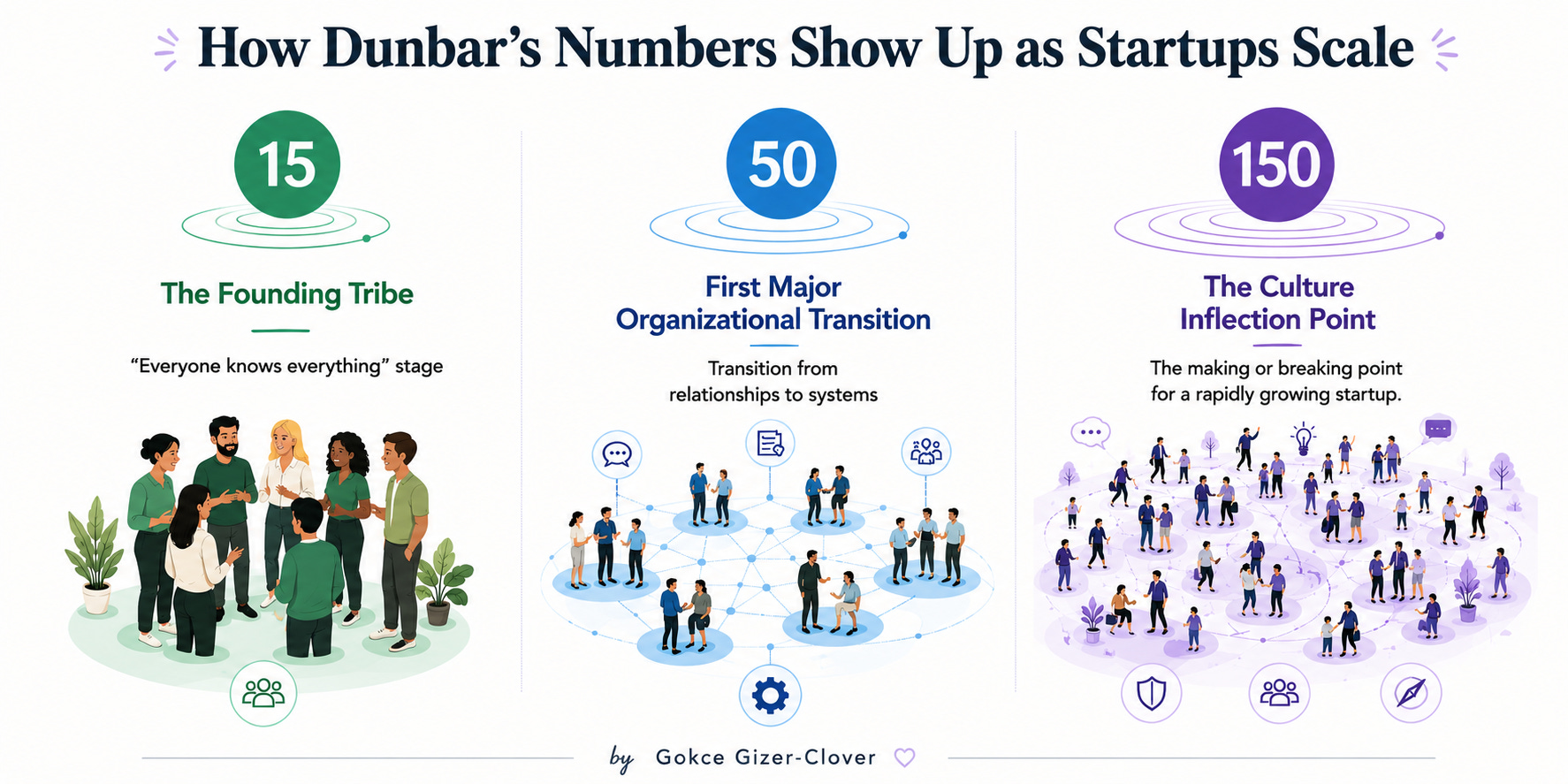
15 People - The Founding Tribe
This is still the “everyone knows everything” stage
Founders directly influence the culture
High trust, high communication
There’s a natural flow of knowledge and information
Fast decisions, quick execution
People are generalists, coordinating organically
At the same time:
Ownership can still be unclear
Most things, if not everything, still go through the founder
There’s heavy reliance on memory rather than systems
This is the stage where you start planting the seeds for the culture that will scale with you: getting clarity on the core purpose of the business, core values, what matters most, and who does what.
Even if you think these things are already clear, going through the exercise as a team and documenting it creates far greater clarity, alignment, and shared understanding.
This is the intentional pause that creates momentum later on.
50 People - First Major Organizational Transition
This is where you transition from relationships to systems
You can no longer rely on people “hearing everything” or communication happening naturally
Culture is no longer spreading organically
The founders can’t, and shouldn’t, directly manage alignment across the organization
Not everybody is responsible for everything anymore
Trust, healthy conflict, and alignment no longer happen naturally on their own
You now need:
Documentation of priorities, values, decisions, processes, roles, and responsibilities
Clear processes for how knowledge gets shared and decisions get made
Communication norms and operational cadence
Explicit values and behaviors that are intentionally reinforced, recognized and celebrated (for example: spending 5 min at the end of a weekly team meeting to celebrate someone who tried and failed that week, to encourage experimentation)
Great team leads across the organization cascading behaviors, messages, and standards
Clearer roles, responsibilities, and accountability
Trust and healthy conflict to be “nurtured” intentionally and systematically
150 People - The Culture Inflection Point
The making or breaking point.
The organization starts carrying the culture.
The expected shifts at this stage:
People no longer know everyone personally
Knowledge doesn’t flow as naturally
Communication might fragment across teams and functions
Founders can no longer personally drive culture, alignment, and motivation
Informal communication and relationships are no longer enough
If the foundations are weak, then misalignment, silos, and politics might emerge
On a positive note, at 150:
There’s a stronger organizational identity and sense of belonging
Things no longer rely on a few key people
Knowledge, ownership, and execution become more distributed
Founders are able to offer teams more autonomy, support, and resources
The organization gains ability to go further, not just faster
Now you start feeling the impact of the foundations you built early on.
And if you haven’t built them yet, you can still go back and build them in, even if it will be a bit harder to untangle things and reshape a culture that has already started to harden.
How have you been experiencing these shifts as you scale?